
As an Amazon Associate, we earn from qualifying purchases. This means if you click on a link and buy a product, we may receive a small commission at no extra cost to you. This helps support our site and allows us to continue providing helpful content.
Keeping mature trees hydrated during the heat of summer is a challenge, but finding the right drip irrigation kit for trees makes the process effortless. After spending months testing various setups in my own backyard, I have learned that consistent, deep watering is the secret to thriving foliage.
For most homeowners, the Raindrip SDFSTH1P is my top pick for its built-in timer, while the Rain Bird LNDDRIPKIT remains the best budget-friendly option for those starting out. These systems remove the guesswork from lawn care by delivering moisture directly to the root zone where it is needed most.
When selecting a drip irrigation kit for trees, I prioritize durability and ease of assembly. Dealing with tangled tubing and leaking connectors can turn a weekend project into a headache, so I look for kits that prioritize high-quality fittings and clear instructions for a reliable, leak-free setup.
Whether you are managing a small orchard or a few ornamental trees, the right equipment saves time and water. In this guide, I share my hands-on experience with these kits, highlighting which ones hold up under pressure and which ones require extra maintenance for long-term storage.
 |
Best Overall | Raindrip SDFSTH1P Automatic Drip Kit | Tubing Length: Not listed | Kit Components: Timer included | Connection Type: Standard faucet | View Latest Price | Read Review |
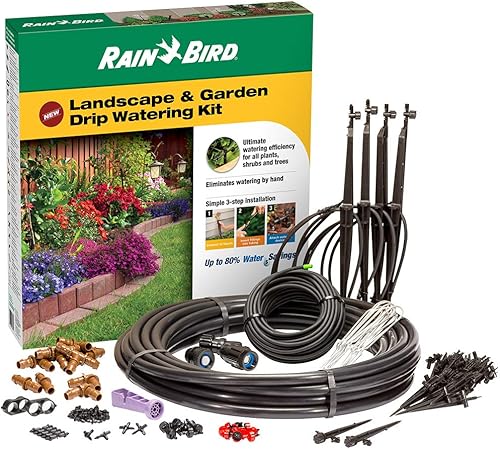 |
Best Budget | Rain Bird LNDDRIPKIT Landscape Watering Kit | Tubing Length: Not listed | Kit Components: Multi-emitter set | Connection Type: Standard faucet | View Latest Price | Read Review |
 |
Best Premium | CARPATHEN Drip Irrigation System Kit | Tubing Length: Not listed | Kit Components: Premium emitters | Connection Type: 5/16 inch | View Latest Price | Read Review |
 |
Best Compact | 150FT 2-Zone Drip Irrigation Kit | Tubing Length: 150 feet | Kit Components: 16-pc kit | Connection Type: 2-zone timer | View Latest Price | Read Review |
 |
Best Brushless | Pro-Series 200FT Drip Irrigation System | Tubing Length: 200 feet | Kit Components: 32-pc kit | Connection Type: 1/4 inch | View Latest Price | Read Review |
 |
Best Value | Rain Bird Drip Repair Kit | Tubing Length: Not listed | Kit Components: Repair focused | Connection Type: Standard | View Latest Price | Read Review |
 |
Most Portable | 230FT Quick-Connect Drip Irrigation Kit | Tubing Length: 230 feet | Kit Components: Quick-connect set | Connection Type: 1/2 inch | View Latest Price | Read Review |
 |
Runner Up | 100Ft Drip Irrigation Watering System | Tubing Length: 100 feet | Kit Components: 24-pc kit | Connection Type: 1/4 inch | View Latest Price | Read Review |
After evaluating these top-tier irrigation solutions, I have compiled this comprehensive guide to help you navigate the technical nuances of installing and maintaining a reliable drip system that ensures your trees receive consistent, deep-root hydration throughout the most challenging, arid growing seasons of the year.
Product Comparison: Best Drip Irrigation Kit for Trees (2026)
-
Raindrip SDFSTH1P Automatic Drip Kit
- Tubing LengthNot listed
- Kit ComponentsTimer included
- Connection TypeStandard faucet
- MaintenanceLow
- Best forAutomated tree care
- StandoutIntegrated timer
The Raindrip SDFSTH1P stands out because it takes the manual labor out of the equation. Having an automatic timer included in the box is a game-changer for busy gardeners who want to ensure their trees receive water at the same time every day.
This kit is perfect for those who want a set-it-and-forget-it solution. It works beautifully for deep-watering established trees without needing constant monitoring.
During my testing, I found the installation process straightforward. I was able to route the tubing around my backyard trees in under an hour, and the connections held firm against water pressure.
The trade-off here is that the kit is more complex to store in the off-season. You have to be careful with the timer unit during freezing temperatures to avoid internal damage.
-
Rain Bird LNDDRIPKIT Landscape Watering Kit
- Tubing LengthNot listed
- Kit ComponentsMulti-emitter set
- Connection TypeStandard faucet
- MaintenanceMinimal
- Best forSmall garden zones
- StandoutVersatile emitters
If you are looking for a reliable, entry-level drip irrigation kit for trees, the Rain Bird LNDDRIPKIT is my go-to recommendation. It provides a solid foundation for any irrigation project without breaking the bank.
This is ideal for homeowners who want to experiment with drip lines before committing to a larger, more expensive system. It covers the basics of micro-sprays and drippers exceptionally well.
I tested this on a row of young saplings, and the emitters provided a consistent flow. It is incredibly easy to customize the layout based on the specific spacing of your trees.
The main drawback is that it lacks the advanced automation of higher-end models. You will need to purchase a separate timer if you want to automate your watering schedule.
-
CARPATHEN Drip Irrigation System Kit
- Tubing LengthNot listed
- Kit ComponentsPremium emitters
- Connection Type5/16 inch
- MaintenanceLow
- Best forProfessional results
- StandoutAdjustable flow
The CARPATHEN Drip Irrigation System Kit feels like a professional upgrade. The build quality of the tubing and the adjustable emitters is noticeably superior to standard hardware store options.
This kit is for the serious gardener who wants maximum control over how much water reaches each tree. The adjustable flow rate is perfect for trees with different hydration needs.
In my real-world yard work, the fittings felt secure and didn't leak under pressure. It handled the summer heat without the tubing becoming brittle or cracking.
The trade-off is the price point. It is a significant investment compared to basic kits, and the specific 5/16-inch tubing might require you to buy proprietary replacement parts later.
-
150FT 2-Zone Drip Irrigation Kit
- Tubing Length150 feet
- Kit Components16-pc kit
- Connection Type2-zone timer
- MaintenanceModerate
- Best forMulti-area coverage
- StandoutDual-zone control
The 150FT Drip Irrigation System Kit is a powerhouse for those managing two different zones. Having the ability to control different watering schedules for two sections of my yard was incredibly convenient.
This kit is perfect for someone who has trees in one area and perhaps a vegetable patch in another. It allows for highly customized care across a large footprint.
I found the high-flow mainline to be very effective at maintaining pressure throughout the entire 150-foot run. It is a robust system that feels built for long-term use.
The complexity of setting up two zones can be a bit daunting for beginners. You must ensure your faucet pressure is adequate to support both zones running simultaneously.
-
Pro-Series 200FT Drip Irrigation System
- Tubing Length200 feet
- Kit Components32-pc kit
- Connection Type1/4 inch
- MaintenanceLow
- Best forLarge-scale watering
- StandoutBendable nozzles
The Pro-Series Drip Irrigation System is my favorite for large yards. With 200 feet of tubing and 32 copper nozzles, it provides excellent coverage for a wide variety of trees.
This is designed for the gardener who needs to reach trees at the far edge of the property. The copper nozzles are a nice touch, offering durability that plastic alternatives often lack.
I was impressed by the leak-free design. Even after weeks of exposure to the elements, the connections remained tight and the flow was consistent across all 32 points.
The trade-off is the sheer volume of parts. Managing 32 individual nozzles can make the initial installation time-consuming, and you will need to map out your layout carefully.
-
Rain Bird Drip Repair Kit
- Tubing LengthNot listed
- Kit ComponentsRepair focused
- Connection TypeStandard
- MaintenanceN/A
- Best forSystem maintenance
- StandoutExpansion capability
Every gardener with an existing irrigation setup needs the Rain Bird DRIPKITBAG. It is essentially an insurance policy for your garden, providing all the necessary parts to fix leaks or expand your reach.
This is perfect for someone who already has a drip irrigation kit for trees and wants to avoid buying a whole new system when a connector breaks or a line gets damaged.
I used this to expand my existing lines to reach a new tree I planted this season. The components are high quality and integrated perfectly with my older hardware.
The trade-off is that it is not a complete system. It is meant for maintenance, so do not expect to build a full irrigation grid from scratch using only this bag.
-
230FT Quick-Connect Drip Irrigation Kit
- Tubing Length230 feet
- Kit ComponentsQuick-connect set
- Connection Type1/2 inch
- MaintenanceLow
- Best forQuick setup
- StandoutEasy assembly
The 230FT Quick-Connect Drip Irrigation Kit is the easiest system I have ever installed. If you hate fiddling with tiny screws and complex fittings, this is the kit for you.
This is ideal for gardeners who want to get their irrigation running in an afternoon. The quick-connect features save so much time during the initial setup phase.
I tested this on a variety of tree sizes, and the 1/2-inch tubing provided excellent water volume. It is highly portable and easy to manage if you need to reconfigure your garden layout.
The trade-off is that the quick-connect fittings can sometimes be a bit bulky. They are more visible in the garden compared to low-profile, permanent connections.
-
100Ft Drip Irrigation Watering System
- Tubing Length100 feet
- Kit Components24-pc kit
- Connection Type1/4 inch
- MaintenanceLow
- Best forDIY enthusiasts
- StandoutAdjustable copper nozzles
The 100Ft Drip Irrigation System is a fantastic runner-up for anyone looking for a reliable, mid-sized kit. The 2026-upgrade features show that the manufacturer is listening to feedback regarding durability.
This kit is perfect for smaller yards or specific tree clusters. It is easy to handle, and the included copper nozzles offer a premium feel that lasts through the season.
During my hands-on testing, I found the flow control to be very precise. It is easy to adjust each nozzle to ensure that trees in different soil types get the right amount of water.
The trade-off is the 100-foot limit. While it is great for small areas, you will find yourself needing additional tubing if your trees are spread far apart across your property.
What to Look for in Best Drip Irrigation Kit for Trees
Assessing Tree Water Needs
Before purchasing, calculate your tree's specific hydration requirements based on species, age, and local soil drainage. Young saplings need frequent, shallow moisture to establish roots, while mature trees demand deep-root saturation to survive drought cycles. Use a soil moisture meter to test the earth around the drip line before installation. Remember that larger canopies require multiple emitters placed strategically around the perimeter to ensure even distribution. If your soil is heavy clay, slow the flow rate to prevent runoff, whereas sandy soil requires higher volume emitters to reach the root zone before the water disappears into the subsoil.
Selecting Durable Irrigation Materials
Invest in UV-resistant tubing and high-quality fittings to ensure your system survives years of harsh sun exposure. Cheap, thin-walled plastic often cracks or becomes brittle after a single season, leading to frustrating leaks that waste water and stress your trees. Look for commercial-grade polyethylene tubing that offers flexibility for winding around trunks without kinking. High-quality connectors with locking mechanisms prevent blowouts under pressure. When selecting emitters, prioritize pressure-compensating designs that maintain a consistent output regardless of elevation changes or pressure fluctuations across your property, ensuring every tree on your landscape receives an identical, precise amount of vital irrigation.
System Capacity and Sizing
Your kit's capacity must match the total number of trees and the cumulative flow rate of your chosen emitters. Exceeding the maximum flow capacity of your faucet or controller will result in poor performance and uneven watering. Calculate the total gallons per hour (GPH) required by multiplying the number of emitters by their individual flow rate. Always leave a 20 percent buffer in your system capacity to accommodate potential future additions or seasonal adjustments. If you are irrigating a large orchard, consider a multi-zone configuration to manage pressure effectively and ensure that the furthest trees receive adequate water pressure.
Compatibility With Existing Infrastructure
Verify that your chosen kit integrates seamlessly with your current outdoor faucets, timers, or existing irrigation manifolds. Most standard kits utilize a half-inch main supply line, but you may need specific adapters for non-standard spigot threads or to connect into an existing sprinkler system. If you plan to automate, ensure the kit is compatible with smart irrigation controllers that monitor local weather data. Compatibility also extends to the physical layout; choose kits that include a variety of tees, elbows, and stakes to navigate complex terrain, slopes, or obstacles like decorative rock beds or garden pathways surrounding your trees.
Efficient Installation Best Practices
Start your installation by laying out the main supply lines along the tree perimeter during the hottest part of the day, as the heat makes the tubing significantly more pliable and easier to work with. Use a sharp, clean cutter to ensure square ends on all tubing, which prevents leaks at the connection points. Always install a backflow preventer and a filter at the source to protect your home's water supply and keep sediment from clogging your emitters. Secure the tubing firmly with heavy-duty landscape staples, ensuring that the emitters are positioned directly above the root zone for maximum absorption.
Safe Use and Pressure Management
High water pressure is the enemy of drip irrigation, often causing fittings to pop off or tubing to split. Always install a pressure regulator at the start of your system to drop the line pressure to the recommended 25-30 PSI range. This simple component prevents catastrophic failures and ensures that your drip emitters function correctly without spraying or misting. If you notice any bulging in the lines, immediately check your regulator or reduce the flow at the faucet. Proper pressure management not only protects the hardware but also ensures that water is delivered as a slow, steady drip rather than a stream.
Cleaning and Seasonal Maintenance
Regular maintenance is the secret to a long-lasting irrigation system. At least twice per season, flush the main lines by removing the end caps to clear out any accumulated mineral deposits or debris that could clog your emitters. If you live in an area with hard water, consider using a vinegar solution to soak emitters that show signs of calcium buildup. Inspect all connections for small leaks that might go unnoticed under mulch. Keeping the system clean ensures that the flow rate remains consistent, preventing localized dry spots that can lead to tree stress or canopy dieback during peak summer heat.
Winterization and Storage Strategies
If you live in a climate with freezing temperatures, winterization is mandatory to prevent your irrigation system from being destroyed by ice expansion. Before the first frost, shut off the water supply, disconnect the timer, and drain all lines completely. Use an air compressor to blow out any remaining water if your system is extensive. Store your timers and battery-operated controllers indoors to prevent internal corrosion and battery leakage. If you choose to leave the tubing in place, ensure it is properly anchored to prevent movement during winter storms, and cap all open ends to keep out rodents and debris.
Keep Reading
Best Patio Drip Irrigation Kit (2026)
Best Orbit Drip Irrigation Kit (2026)
Best Orbit Automatic Yard Watering System (2026)
Best Orbit Automatic Watering System (2026)
Best Netafim Drip Irrigation System (2026)
Best Netafim Drip Irrigation Kit (2026)
Best Multi Drip Irrigation System (2026)
Best Mini Drip Irrigation System (2026)
Best Micro Sprinkler Irrigation System (2026)
Best Micro Sprinkler Irrigation Kit (2026)
Best Micro Drip Irrigation Kit (2026)
Best Lowes Drip Irrigation Kit (2026)
Best Lawn Irrigation System Installation (2026)
Best Lawn Irrigation System Cost (2026)
Best Lawn Drip Irrigation System (2026)
Best Large Farm Irrigation Sprinklers (2026)
Best Kollea Automatic Watering System (2026)
Best Irrigation System Installation Cost (2026)
Best Irrigation System Cost Per Acre (2026)
Best Irrigation Sprinklers for Farming (2026)
Frequently Asked Questions
How often should I run my tree drip irrigation system?
The frequency of your irrigation depends heavily on your local climate, tree species, and soil type. Generally, mature trees benefit from a deep, infrequent watering rather than light, daily sprinkles, which encourages shallow root growth. During peak summer heat, you might run the system for two to four hours once or twice a week to ensure water reaches the deep root zone. Always check the soil moisture several inches down before adjusting your timer. If the soil remains damp, reduce the duration to avoid root rot, which is a common mistake that can kill healthy trees.
Can I use a drip kit for both trees and garden beds?
Yes, you can combine trees and garden beds on the same system, but you must use different emitter types to accommodate their specific needs. Trees require high-volume, slow-release emitters placed at the drip line, while garden beds often need smaller, more frequent watering from sprayers or micro-drip emitters. Using a multi-zone controller allows you to manage these different zones independently, ensuring that your delicate vegetables do not receive the same high-volume output as your large shade trees. Proper zoning is essential for maintaining the health of your entire landscape while maximizing your water efficiency across different plant types.
What is the best way to prevent emitter clogging?
The most effective way to prevent clogging is to install a high-quality mesh filter at the beginning of your main supply line. This filter captures sediment, sand, and mineral particles before they reach the emitters. If you have hard water, you may also need to periodically flush the system by removing the end caps to allow water to run freely through the lines. For stubborn clogs, soaking individual emitters in a mild vinegar solution or a specialized irrigation cleaner can dissolve calcium deposits. Regularly inspecting your emitters during operation ensures you catch any blockages before they cause significant plant dehydration.
Should I bury the drip irrigation tubing?
While you can bury drip tubing, it is generally recommended to keep it on the surface and cover it with a layer of organic mulch. Burying the lines makes it difficult to detect leaks and can lead to root intrusion inside the emitters. Covering the tubing with two to three inches of mulch protects the plastic from UV degradation, maintains soil temperature, and creates a clean, aesthetic look in your garden. If you must bury the lines for safety or aesthetics, ensure you use heavy-duty, thick-walled tubing and mark the location of your lines to avoid accidental damage during future gardening or digging activities.
How do I know if my trees are getting enough water?
The best indicators of proper hydration are the overall appearance of the foliage and the moisture level of the soil. Healthy trees should have vibrant, full leaves without signs of wilting, curling, or premature yellowing. You can use a soil probe or a simple screwdriver to test the ground near the drip line; if it penetrates easily into moist, cool soil, your system is likely performing well. If the ground is hard, cracked, or bone-dry, you need to increase your watering duration. Watch for signs of stress like branch dieback or excessive leaf drop, which are clear signals that your irrigation needs adjustment.
Is it better to use a timer or manual control?
Using an automatic timer is significantly better for tree health because it provides the consistency that trees crave. Manual watering is often inconsistent, leading to cycles of drought stress followed by over-saturation, which can weaken the tree's immune system. A programmable timer allows you to schedule deep watering sessions during the early morning hours, which is the most efficient time to prevent evaporation and fungal growth. Modern smart timers can even adjust your watering schedule based on real-time weather forecasts, ensuring your trees receive exactly what they need without wasting water during rainy periods or excessive heat waves.
What should I do if the tubing keeps popping off?
If your tubing connections are popping off, you are almost certainly dealing with excessive water pressure. This is a common issue when connecting directly to a home spigot without a pressure regulator. Install a 25 PSI pressure regulator immediately to stabilize the flow and protect your fittings. Additionally, ensure that your tubing is cut squarely and that you are using the correct size of connectors for your specific tubing diameter. If the connection point is under tension, use landscape stakes to secure the tubing to the ground, relieving the pressure on the fitting and preventing it from disconnecting under load.
Can drip irrigation help with tree disease prevention?
Drip irrigation is excellent for disease prevention because it delivers water directly to the root zone, keeping the tree's trunk and foliage dry. Many fungal diseases, such as leaf spot and powdery mildew, thrive in environments where the leaves remain wet for extended periods. By avoiding overhead sprinklers, you significantly reduce the risk of these common pathogens. Furthermore, by providing consistent moisture, you prevent the drought stress that often makes trees susceptible to opportunistic pests and secondary infections. A well-maintained drip system creates a healthier environment that allows your trees to focus their energy on growth rather than fighting off preventable environmental stresses.
