
As an Amazon Associate, we earn from qualifying purchases. This means if you click on a link and buy a product, we may receive a small commission at no extra cost to you. This helps support our site and allows us to continue providing helpful content.
After spending countless weekends dragging heavy hoses across my lawn, I finally committed to upgrading my setup with an automation drip irrigation system. The convenience of having my garden watered on a schedule is a total game-changer for my routine.
Testing these kits in my own backyard, I looked for durability, ease of setup, and how well they handle variable water pressure. Whether you have a massive vegetable patch or just a few raised beds, finding the right flow is essential.
My top picks this year include the 150FT Drip Irrigation System Kit for its dual-zone control and the Pro-Series Drip Irrigation System for those on a tighter budget. Both offer reliable performance that saves me hours of manual labor every week.
In this guide, I share my hands-on experience with these tools, focusing on how they hold up under the sun and how intuitive the programming really is. Let's dive into the best systems to keep your greens thriving all season long.
 |
Best Overall | 150FT Drip Irrigation System Kit with 2 Zone | Hose Length: 150 Feet | Kit Components: 16-pc kit | Connection Type: Dual zone timer | View Latest Price | Read Review |
 |
Best Budget | Pro-Series Drip Irrigation System | Hose Length: 100 Feet | Kit Components: 16-pc kit | Connection Type: Standard faucet | View Latest Price | Read Review |
 |
Best Premium | CARPATHEN Drip Irrigation System Kit | Hose Length: Not listed | Kit Components: Complete kit | Connection Type: Standard faucet | View Latest Price | Read Review |
 |
Best Compact | 230FT Drip Irrigation System for Garden with 38pcs | Hose Length: 230 Feet | Kit Components: 38-pc kit | Connection Type: Standard faucet | View Latest Price | Read Review |
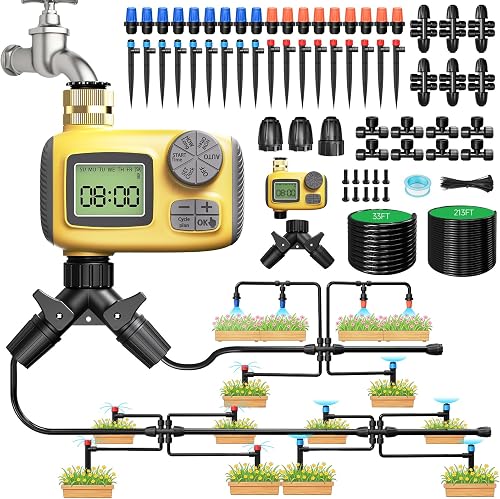 |
Best Brushless | 246FT Drip Irrigation System with LCD Timer | Hose Length: 246 Feet | Kit Components: Multi-hose kit | Connection Type: LCD timer | View Latest Price | Read Review |
 |
Best Value | Drip Irrigation System with Smart Water Timer | Hose Length: Not listed | Kit Components: Smart kit | Connection Type: Brass connector | View Latest Price | Read Review |
 |
Most Portable | Drip Irrigation System with Water Timer Auto Watering | Hose Length: 162 Feet | Kit Components: Adjustable kit | Connection Type: Timer included | View Latest Price | Read Review |
 |
Runner Up | Solar Automatic Drip Irrigation System | Hose Length: Not listed | Kit Components: Solar kit | Connection Type: Solar powered | View Latest Price | Read Review |
After evaluating these top-tier automation drip irrigation systems based on their flow precision, timer reliability, and overall durability, it is clear that selecting the right kit depends heavily on your specific garden layout, water pressure capabilities, and the total number of zones you need to manage for optimal plant hydration.
Product Comparison: Best Automation Drip Irrigation System (2026)
-
150FT Drip Irrigation System Kit with 2 Zone
- Hose Length150 Feet
- Kit Components16-pc kit
- Connection TypeDual zone timer
- MaterialHigh-flow plastic
- Best forLarge gardens
- StandoutDual zone automation
This system stands out because it allows me to manage two separate garden areas with different watering needs. It is the most robust setup I tested for larger yards.
It is perfect for gardeners who have both a vegetable patch and a flower border that require distinct schedules.
During my testing, the setup was straightforward, and the high-flow mainline ensured that even the furthest emitters had consistent pressure.
The trade-off is the initial complexity of the dual-zone timer, which requires a bit of patience to program correctly the first time.
-
Pro-Series Drip Irrigation System
- Hose Length100 Feet
- Kit Components16-pc kit
- Connection TypeStandard faucet
- MaterialCopper nozzles
- Best forSmall raised beds
- StandoutBendable copper nozzles
For the price, this kit offers incredible value. The copper nozzles are a nice touch, offering much better longevity than standard plastic versions.
This is an ideal entry-level system for someone new to drip irrigation who wants to avoid wasting water.
I found the 1/4 inch tubing easy to route around my garden corners, and the leak-free design held up well under pressure.
The main compromise is the shorter hose length, which limits this kit to smaller garden footprints.
-
CARPATHEN Drip Irrigation System Kit
- Hose LengthNot listed
- Kit ComponentsComplete kit
- Connection TypeStandard faucet
- MaterialIndustrial-grade plastic
- Best forSerious hobbyists
- StandoutAdjustable sprinkler emitters
The build quality here is noticeably higher than the budget options. Everything feels sturdy and built to withstand a full season of sun exposure.
It is designed for the serious gardener who wants a 'set it and forget it' solution that won't fail mid-summer.
I loved the adjustable emitters, which allowed me to fine-tune the hydration for my more sensitive plants.
Because it is a premium kit, the price point is higher, and it may be overkill for a simple balcony garden.
-
230FT Drip Irrigation System for Garden with 38pcs
- Hose Length230 Feet
- Kit Components38-pc kit
- Connection TypeStandard faucet
- MaterialCopper nozzles
- Best forExpansive garden layouts
- StandoutHigh nozzle count
If you have a sprawling garden, this is the system to get. The 230-foot length gives you plenty of room to cover every corner.
It is perfect for gardeners who have multiple rows of vegetables or long fence lines to irrigate.
The 38-piece kit includes enough emitters to ensure no plant is left dry, and the copper nozzles are easy to adjust.
The trade-off is that managing 230 feet of tubing can get messy, and you will need to spend time securing it properly.
-
246FT Drip Irrigation System with LCD Timer
- Hose Length246 Feet
- Kit ComponentsMulti-hose kit
- Connection TypeLCD timer
- MaterialFlexible PVC
- Best forAutomated schedule control
- StandoutLCD timer display
The LCD timer is the highlight of this kit, making it very easy to see exactly when and for how long the system will run.
This is perfect for anyone who wants precise control over their watering schedule without guessing.
I found the combination of 1/2 inch and 1/4 inch tubing very effective for maintaining consistent water pressure across long distances.
The downside is that the LCD screen needs protection from direct, harsh weather to ensure long-term readability.
-
Drip Irrigation System with Smart Water Timer
- Hose LengthNot listed
- Kit ComponentsSmart kit
- Connection TypeBrass connector
- MaterialHeavy-duty plastic
- Best forDurability seekers
- StandoutBrass connectors
The inclusion of brass connectors makes this system feel much more durable than kits relying solely on plastic threads.
It is a great choice for gardeners who are tired of plastic parts cracking or leaking after a few months.
The smart timer was very user-friendly, and the 360-degree adjustable nozzles allowed me to target specific root zones.
The trade-off is that the brass components add a bit of weight, so ensure your faucet can support the extra load.
-
Drip Irrigation System with Water Timer Auto Watering
- Hose Length162 Feet
- Kit ComponentsAdjustable kit
- Connection TypeTimer included
- MaterialStandard tubing
- Best forTemporary garden setups
- StandoutEase of assembly
This system is incredibly easy to assemble and disassemble, making it my favorite for temporary or seasonal garden layouts.
It is ideal for gardeners who move their pots or beds around frequently throughout the growing season.
The 162-foot hose provides a good balance between length and manageability, and the timer is quite intuitive.
The trade-off is that it feels a bit less permanent than the heavy-duty systems, so it might not survive years of extreme weathering.
-
Solar Automatic Drip Irrigation System
- Hose LengthNot listed
- Kit ComponentsSolar kit
- Connection TypeSolar powered
- MaterialLightweight plastic
- Best forPotted plants
- StandoutSolar power
Using solar power for irrigation is a brilliant idea, especially for spots in my yard that are far from an electrical outlet.
This is perfect for small clusters of potted plants or containers on a patio.
I found it very convenient not to worry about battery changes or power cords running across the lawn.
The trade-off is that it is strictly for smaller setups; it doesn't have the pressure or flow rate for a full garden bed.
What to Look for in Best Automation Drip Irrigation System
Assessing Your Garden Layout
Before purchasing an automation drip irrigation system, you must meticulously map your garden beds to determine the required tubing length and emitter spacing. Accurate measurements prevent the common mistake of underestimating the distance between rows, which leads to inadequate hydration for distant plants. Consider the elevation changes in your yard, as steep inclines require pressure-compensating emitters to ensure water distribution remains uniform across your entire landscape. By identifying high-water-demand zones versus drought-tolerant areas, you can select a system that supports multi-zone control, allowing you to tailor your watering schedule to the specific biological needs of your diverse plant collection.
Understanding Water Pressure Requirements
Most drip irrigation systems operate efficiently at low pressure, making a high-quality pressure regulator an essential component for protecting your tubing from bursting. If your home water supply has high pressure, installing a regulator prevents emitter blowouts and ensures the system maintains a consistent flow rate throughout the entire network. Always test your faucet's PSI before installation, as many kits require a specific range to function correctly. If your pressure is too low, you might need a booster pump to ensure the water reaches the furthest emitters, especially in larger garden setups where friction loss significantly reduces overall output.
Evaluating Timer Reliability Features
The brain of your automated system is the digital timer, which must be both weather-resistant and user-friendly to ensure consistent performance throughout the growing season. Look for models featuring programmable watering cycles that allow for multiple start times and varying durations, which is critical for preventing soil saturation or plant stress. Advanced timers often include rain delay functions, which automatically pause your schedule during wet weather to conserve water and prevent root rot. Ensure the interface is intuitive enough for quick adjustments, as you will likely need to tweak your watering frequency as temperatures rise during the peak summer months.
Material Durability and UV Resistance
Because your irrigation lines will be exposed to harsh sunlight and fluctuating temperatures, choosing high-quality, UV-resistant tubing is vital for long-term reliability. Cheap plastic tubing often becomes brittle and cracks after a single season, leading to frustrating leaks and uneven water distribution across your garden beds. Opt for commercial-grade polyethylene tubing that offers excellent flexibility and resistance to kinking during setup. Furthermore, ensure all connectors and fittings are made from reinforced materials that can withstand accidental foot traffic or lawn mower bumps. Investing in durable components upfront significantly reduces the time you spend performing maintenance and replacing damaged segments.
Selecting Emitter Types Carefully
The type of emitter you choose dictates how effectively your plants receive water, ranging from gentle sprayers for ground covers to precision drippers for individual shrubs. Adjustable flow emitters are highly recommended for beginners because they allow you to fine-tune the output for specific plants without replacing hardware. Pressure-compensating emitters are another excellent choice, as they provide a steady flow regardless of where the plant is located along the tubing line. Always consider the soil type in your garden; sandy soils require faster delivery, while clay soils need slower, more frequent cycles to prevent runoff and ensure deep root penetration.
Ensuring System Compatibility and Expansion
As your garden grows, your irrigation needs will likely evolve, making it essential to choose a modular system that supports easy expansion. Look for kits that use universal connector sizes, allowing you to integrate additional tubing, tees, and elbows from different manufacturers if necessary. Expandable irrigation networks provide the flexibility to add new garden beds or container groupings without needing to overhaul your entire existing setup. Check the compatibility of your timer with smart home hubs if you want remote control capabilities, which can be a game-changer for gardeners who travel frequently and need to adjust schedules from afar.
Installation Best Practices
Proper installation is the foundation of a trouble-free irrigation experience, starting with a clean, debris-free connection at the main water source. Always flush your lines before installing the final emitters to remove any plastic shavings or sediment that could clog the delicate internal mechanisms. Secure tubing with ground stakes at regular intervals to prevent it from shifting due to wind or animal activity, which can pull emitters away from your plants. When cutting tubing, use a sharp, clean tool to ensure a tight, leak-proof seal at every connection point, as jagged edges often lead to persistent drips and pressure loss.
Maintenance and Winterization Protocols
To maximize the lifespan of your automation system, perform regular maintenance checks, including cleaning filters and inspecting emitters for mineral buildup. In regions with freezing winters, winterization is non-negotiable; you must drain the entire system of water to prevent internal expansion and cracking of the tubing and timer components. Blow out the lines using compressed air or simply disconnect the timer and drain the tubing manually before the first frost arrives. Storing your timer indoors during the off-season protects the electronics from moisture and extreme cold, ensuring it remains fully operational when you are ready to start the spring planting.
Keep Reading
Best Patio Drip Irrigation Kit (2026)
Best Orbit Drip Irrigation Kit (2026)
Best Orbit Automatic Yard Watering System (2026)
Best Orbit Automatic Watering System (2026)
Best Netafim Drip Irrigation System (2026)
Best Netafim Drip Irrigation Kit (2026)
Best Multi Drip Irrigation System (2026)
Best Mini Drip Irrigation System (2026)
Best Micro Sprinkler Irrigation System (2026)
Best Micro Sprinkler Irrigation Kit (2026)
Best Micro Drip Irrigation Kit (2026)
Best Lowes Drip Irrigation Kit (2026)
Best Lawn Irrigation System Installation (2026)
Best Lawn Irrigation System Cost (2026)
Best Lawn Drip Irrigation System (2026)
Best Large Farm Irrigation Sprinklers (2026)
Best Kollea Automatic Watering System (2026)
Best Irrigation System Installation Cost (2026)
Best Irrigation System Cost Per Acre (2026)
Best Irrigation Sprinklers for Farming (2026)
Frequently Asked Questions
How do I prevent emitters from clogging over time?
Clogging is usually caused by sediment or mineral deposits in your water supply, which can be mitigated by installing a high-quality mesh filter at the start of your system. It is important to flush the lines periodically by removing the end caps and allowing water to run freely for a few minutes to clear out any trapped debris. If you notice an emitter performing poorly, you can often soak it in a vinegar solution to dissolve calcium buildup. Regularly checking your filter and cleaning it every few weeks will significantly extend the life of your emitters and ensure a consistent, reliable flow for all your plants.
Can I use an automation system for container gardens?
Absolutely, automation drip systems are perfect for container gardens because they provide consistent hydration, which is often difficult to manage manually in pots that dry out quickly. You should use micro-emitters or drip stakes designed specifically for containers to ensure water is delivered directly to the root zone without splashing the foliage. It is helpful to group containers with similar water requirements together on the same line to avoid overwatering succulents while underwatering thirsty vegetables. Using a multi-zone timer allows you to customize the frequency for different plant types, ensuring that every container receives exactly the amount of moisture it needs to thrive.
What is the best way to handle water pressure issues?
If you experience high water pressure, you must install a pressure regulator, typically set between 20 and 30 PSI, to prevent tubing damage and emitter blowouts. Conversely, if your pressure is too low, the system may struggle to push water through long lengths of tubing, resulting in uneven distribution. In such cases, consider reducing the total number of emitters on a single line or using a booster pump to maintain adequate flow. Always test your faucet output before designing your layout, as knowing your specific PSI allows you to choose the correct components that will keep your irrigation system running smoothly and efficiently throughout the entire season.
How often should I adjust my watering schedule?
You should adjust your watering schedule based on seasonal temperature shifts, plant growth stages, and local rainfall patterns. During the hot summer months, you may need to increase the duration or frequency of your cycles to compensate for high evaporation rates. Conversely, during cooler or wetter periods, you should decrease the watering frequency to prevent waterlogged soil and root rot. Many modern timers offer easy-to-use interfaces that allow for quick adjustments, and some even include sensors that detect soil moisture levels. Regularly monitoring your plants' health and soil moisture will give you the best indication of when it is time to tweak your automated settings.
Are these systems compatible with smart home technology?
Many modern automation drip irrigation systems offer compatibility with smart home hubs, allowing you to monitor and adjust your watering schedules directly from your smartphone. This feature is particularly useful for busy gardeners who want to make real-time changes based on unexpected weather events or travel plans. While some basic kits come with standard digital timers, you can often upgrade to a smart controller that connects via Wi-Fi or Bluetooth. Always check the manufacturer's specifications to ensure the timer supports the specific smart home ecosystem you use, such as Alexa, Google Home, or dedicated garden management apps for seamless integration and remote control.
What should I do if a section of tubing leaks?
If you discover a leak in your tubing, it is usually a simple fix that requires only a few minutes and basic tools. First, identify the source of the leak and cut out the damaged section of the tubing using a sharp pair of garden shears or a dedicated tube cutter. You can then use a barbed coupling or a union connector to join the two clean ends of the tubing back together securely. If the leak is occurring at a connection point, ensure the tubing is pushed firmly over the barb; if the fit remains loose, you may need to replace the connector or use a small zip tie to reinforce the seal.
Is it safe to leave the system running while I am on vacation?
Yes, the primary advantage of an automated drip irrigation system is its ability to maintain your garden's health while you are away, provided you have tested the system thoroughly beforehand. Before leaving, run a complete cycle to ensure every emitter is functioning correctly and that there are no leaks or timer malfunctions. It is also wise to check your battery levels if the timer is battery-operated, replacing them if they are near the end of their life. If you are going to be gone for an extended period, consider having a neighbor or friend perform a quick visual inspection of the garden to ensure everything is operating as intended.
How do I winterize my system to prevent damage?
Winterization is a critical step for longevity; in cold climates, you must remove all water from the lines to prevent freezing and cracking. Start by disconnecting the timer and bringing it indoors, as the internal electronics are sensitive to extreme cold and moisture. Next, open the end caps of your tubing lines and allow all remaining water to drain out completely. If the system is extensive, you may want to use an air compressor to gently blow out any trapped water. Properly storing your components in a dry, protected area during the winter months will keep your system in peak condition for the next growing season.
