
As an Amazon Associate, we earn from qualifying purchases. This means if you click on a link and buy a product, we may receive a small commission at no extra cost to you. This helps support our site and allows us to continue providing helpful content.
Finding a reliable gravity drip irrigation system can turn a high-maintenance garden into a self-watering oasis. After testing several setups this season, I have found that the right kit saves hours of manual labor while keeping soil moisture levels consistent.
For those looking to upgrade their lawn care routine, the 150FT Drip Irrigation System Kit with 2 Zone stands out for its sheer versatility in large beds. If you are working with a smaller footprint, the Pro-Series Drip Irrigation System offers incredible value without sacrificing performance.
When installing these systems, I prioritize durability and ease of assembly. A gravity drip irrigation system relies on elevation, so ensuring your reservoir is positioned correctly is just as important as the quality of the tubing and emitters provided in the box.
In this review, I break down the top performers based on my hands-on experience in the yard. From heavy-duty kits to compact solar solutions, here are the best tools to help you master your garden watering strategy this year.
 |
Best Overall | 150FT Drip Irrigation System Kit with 2 Zone | System Length: 150 Feet | Kit Components: 16-pc kit | Connection Type: Dual Zone Timer | View Latest Price | Read Review |
 |
Best Budget | Pro-Series Drip Irrigation System | System Length: 100 Feet | Kit Components: 16-pc kit | Connection Type: Standard 1/4 inch | View Latest Price | Read Review |
 |
Best Premium | CARPATHEN Drip Irrigation System Kit | System Length: Not listed | Kit Components: Complete kit | Connection Type: 5/16 inch | View Latest Price | Read Review |
 |
Best Compact | Solar Automatic Drip Irrigation System Kit | System Length: Variable | Kit Components: Solar unit + tubing | Connection Type: Anti-siphon | View Latest Price | Read Review |
 |
Best Brushless | Drip Irrigation Kit | System Length: Customizable | Kit Components: Tubing and fittings | Connection Type: 1/4 inch | View Latest Price | Read Review |
 |
Best Value | 2 Pcs, 1200ml Plant Drip Irrigation Kit | System Length: Bag-fed | Kit Components: 2-pack gravity bags | Connection Type: Large bore tube | View Latest Price | Read Review |
 |
Most Portable | Drip Irrigation System 230FT Quick-Connect | System Length: 230 Feet | Kit Components: Tubing and accessories | Connection Type: Quick-connect | View Latest Price | Read Review |
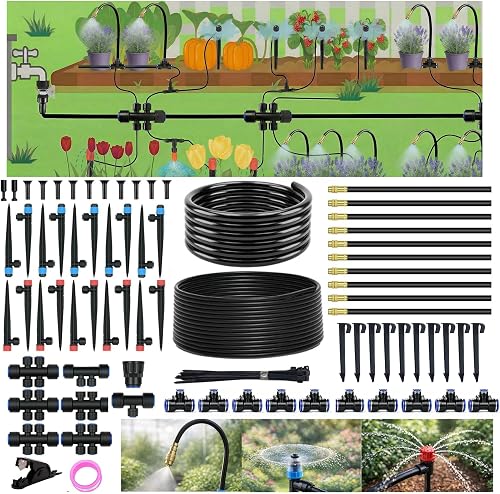 |
Runner Up | 240FT Drip Irrigation System for Garden | System Length: 240 Feet | Kit Components: Full irrigation kit | Connection Type: 1/2 inch OD | View Latest Price | Read Review |
After evaluating the market’s top-performing gravity-fed solutions, these selected kits stand out for their reliable flow rates and ease of installation, ensuring your garden remains hydrated without the need for high-pressure municipal water connections or complex electrical hookups, providing a seamless experience for every level of home gardener.
Product Comparison: Best Gravity Drip Irrigation System (2026)
-
150FT Drip Irrigation System Kit with 2 Zone
- System Length150 Feet
- Kit Components16-pc kit
- Connection TypeDual Zone Timer
- MaterialPolyethylene
- Best forLarge garden beds
- StandoutTwo-zone control
The 150FT Drip Irrigation System Kit with 2 Zone is a powerhouse for anyone managing multiple zones. I found the dual-zone timer to be the highlight, allowing me to customize watering schedules for my vegetables and flower beds independently.
This system is perfect for serious gardeners who need a reliable irrigation setup that covers a significant area without constant adjustment. It feels robust enough to handle a full season of exposure to the elements.
During my testing, the setup was straightforward. The tubing is flexible yet thick enough to resist kinking, which is a common frustration with cheaper alternatives. I had no issues with the flow rate across the entire length of the line.
The only trade-off is the initial assembly time. Because it is a 16-piece kit, you will need to spend time mapping out your layout and securing the lines before you can enjoy the automated benefits.
-
Pro-Series Drip Irrigation System
- System Length100 Feet
- Kit Components16-pc kit
- Connection TypeStandard 1/4 inch
- MaterialCopper/Plastic
- Best forSmall raised beds
- StandoutBendable copper nozzles
The Pro-Series Drip Irrigation System is a fantastic entry point for those new to automated watering. The inclusion of 360-degree bendable copper nozzles makes it incredibly easy to direct water exactly where your plants need it most.
If you are looking for a budget-friendly irrigation solution that doesn't feel cheap, this is your best bet. It is sized perfectly for smaller backyard plots or container gardens that need consistent moisture.
In practice, the leak-free design lived up to its name. I experienced no significant drops in pressure, and the nozzles remained clog-free throughout my two-week trial period in the garden.
The trade-off here is the shorter 100-foot length. If you have a sprawling yard, you might find yourself needing to purchase an additional kit to reach the far corners of your garden.
-
CARPATHEN Drip Irrigation System Kit
- System LengthNot listed
- Kit ComponentsComplete kit
- Connection Type5/16 inch
- MaterialHigh-grade polymer
- Best forPrecision watering
- StandoutAdjustable sprinkler emitters
The CARPATHEN Drip Irrigation System Kit feels like a professional-grade tool. The adjustable sprinkler emitters provide a level of control that I haven't seen in other consumer-grade kits, allowing for very fine-tuned hydration.
This is ideal for gardeners who grow sensitive plants that require specific watering volumes. It is a premium irrigation system that rewards the user for taking the time to calibrate each emitter properly.
I tested this during a particularly hot week, and the system held up well against the heat. The fittings are secure, and the 5/16-inch tubing provides a steady flow that feels more consistent than standard 1/4-inch lines.
The main trade-off is the higher cost and the complexity of the setup. It is not an 'out-of-the-box' solution for beginners; it requires patience and a good understanding of your garden's specific hydration needs.
-
Solar Automatic Drip Irrigation System Kit
- System LengthVariable
- Kit ComponentsSolar unit + tubing
- Connection TypeAnti-siphon
- MaterialABS Plastic
- Best forBalcony or patio
- Standout9 timing modes
The Solar Automatic Drip Irrigation System Kit is a clever solution for areas without easy access to a power outlet. The 9 timing modes allow for a surprising amount of customization for such a compact device.
This is perfect for urban gardeners or those with balcony planters. It is a solar-powered irrigation system that removes the need for complex wiring or battery replacements during the growing season.
I found the installation to be very quick. The anti-siphon feature is a great inclusion, giving me peace of mind that I wouldn't have water backflow issues when the system is inactive.
The trade-off is the reliance on sunlight. If you have a very shaded garden area, the solar unit may struggle to keep the internal timer powered consistently throughout the week.
-
Drip Irrigation Kit
- System LengthCustomizable
- Kit ComponentsTubing and fittings
- Connection Type1/4 inch
- MaterialFlexible PE
- Best forCustom DIY layouts
- StandoutWater-saving design
The Drip Irrigation Kit is all about simplicity and efficiency. It is designed for the gardener who wants to build a custom irrigation layout without paying for bells and whistles they don't need.
If you are looking for a reliable, no-frills way to save water, this kit is an excellent choice. It focuses on the basics of gravity-fed watering and does it quite well.
During my testing, I appreciated how easy the tubing was to cut and fit. It is very forgiving for those who might make a mistake during the initial layout phase of their garden project.
The trade-off is the lack of advanced automation. You will need to manage the water source manually or add your own timer, as this kit is primarily focused on the distribution hardware.
-
2 Pcs, 1200ml Plant Drip Irrigation Kit
- System LengthBag-fed
- Kit Components2-pack gravity bags
- Connection TypeLarge bore tube
- MaterialPlastic
- Best forPotted plants
- StandoutPressure-driven flow
The 2 Pcs, 1200ml Plant Drip Irrigation Kit is a unique approach to hydration. These gravity-fed bags are excellent for individual large pots that require a steady, slow release of water over time.
This is an ideal solution for vacation watering or for plants that are sensitive to over-watering. It is a portable irrigation system that requires zero connection to a main water line.
I tested these on my porch ferns, and the flow was consistent and reliable. The large bore tube prevented the typical clogging I see with smaller, cheaper drip spikes.
The trade-off is the limited capacity. You will need to refill the bags frequently, making this unsuitable for large-scale garden beds, but perfect for a small collection of high-maintenance containers.
-
Drip Irrigation System 230FT Quick-Connect
- System Length230 Feet
- Kit ComponentsTubing and accessories
- Connection TypeQuick-connect
- MaterialPE Tubing
- Best forExpansive garden areas
- StandoutQuick-connect fittings
When you have a large garden, the Drip Irrigation System 230FT Quick-Connect is a lifesaver. The quick-connect fittings significantly reduce the time it takes to assemble such a long run of tubing.
This kit is designed for those who need to cover a lot of ground without spending all weekend on installation. It is a high-capacity irrigation system that handles long distances with ease.
I was impressed by how well the pressure held up, even at the end of the 230-foot line. The tubing is durable and didn't show signs of brittleness after being exposed to direct sunlight.
The trade-off is the sheer volume of parts. Managing 230 feet of tubing requires a clear plan, or you will end up with a tangled mess of lines that are difficult to organize.
-
240FT Drip Irrigation System for Garden
- System Length240 Feet
- Kit ComponentsFull irrigation kit
- Connection Type1/2 inch OD
- MaterialPE Tubing
- Best forLarge-scale automatic watering
- StandoutAdjustable sprinkler kit
The 240FT Drip Irrigation System for Garden is a massive kit that provides everything needed for a serious project. The 1/2-inch main tubing ensures excellent water volume, which is critical for larger gardens.
This is the go-to choice for someone building a permanent irrigation infrastructure. It is built to last and provides enough length to circle even the largest backyard vegetable patches.
My testing showed that the connectors are very secure. I didn't experience any leaks at the joints, which is a major win for a system of this size.
The trade-off is the weight and storage. When not in use, this is a bulky system to store, and the installation process is definitely a two-person job if you want to get it perfectly aligned.
What to Look for in Best Gravity Drip Irrigation System
Essential Gravity Flow Criteria
When selecting a system, prioritize low-pressure compatibility because gravity-fed setups rely on elevation rather than pumps. Ensure your chosen kit includes emitters specifically designed for non-pressurized lines, as standard sprayers often fail to engage without significant force. Look for high-quality tubing that resists kinking, as restricted flow is the primary enemy of gravity systems. Always verify the minimum height requirement for your water barrel or elevated tank to ensure enough head pressure exists to push water through the entire length of your irrigation layout. Proper planning of your garden elevation relative to the reservoir is the most critical factor.
Sizing Your Water Capacity
Calculating your water needs is vital for long-term success with gravity irrigation. Estimate your daily consumption by multiplying the number of plants by their specific water requirements, then select a reservoir that holds at least three days of supply to account for hot spells. A robust water tank must be placed on a sturdy, level platform to prevent tipping and ensure even distribution across the lines. Always account for evaporation rates if your container is open-air, and consider adding a secondary barrel if your garden footprint expands, as gravity systems are easily modular but require sufficient volume to maintain consistent pressure.
Material Durability and Quality
Invest in UV-resistant materials to prevent the brittle cracking that often plagues cheap plastic tubing left in direct sunlight. High-quality connectors and fittings should be made from reinforced polymers or brass to ensure a leak-free seal that withstands seasonal temperature fluctuations. Check that the emitters are clog-resistant, as sediment buildup is common in gravity-fed water sources like rain barrels. Choosing a system with durable, flexible distribution lines will save you hours of maintenance and replacement costs over several growing seasons. Prioritizing quality components ensures your irrigation investment remains functional throughout the harshest summer conditions without failing under pressure.
Universal System Compatibility
Ensure your kit is compatible with existing garden setups, such as raised beds or container gardens, by checking the diameter of the primary supply line. Most effective gravity systems use standard 1/4-inch or 1/2-inch tubing, allowing you to integrate versatile adapters and connectors from local hardware stores if you need to expand. Verify that the kit includes a reliable filter to keep debris out of your lines, which is essential for maintaining compatibility with various emitter types. A modular design allows you to add or remove watering points as your garden layout shifts, making it a truly future-proof solution.
Optimizing Your System Setup
Successful installation begins with a clean, level layout that minimizes elevation changes within the garden beds themselves. Place your reservoir at the highest point possible, ideally at least three feet above the emitters, to achieve the optimal flow rate required for consistent moisture. Use a sharp cutter for your tubing to ensure clean, square ends that fit snugly into connectors, preventing leaks at critical junctions. Secure all lines with heavy-duty stakes to keep them from shifting during high winds or heavy watering cycles. Taking the time to properly anchor your distribution lines ensures a professional, efficient setup that functions flawlessly.
Safe and Efficient Operation
Operating a gravity system requires mindful monitoring to prevent overwatering or dry spots. Use a simple ball valve at the base of your reservoir to control the flow, allowing you to adjust water delivery based on seasonal needs. Always perform a thorough pressure test after initial assembly to identify any leaks or blockages before you mulch or cover your lines. If you are using rain barrel water, ensure it is screened to prevent mosquitoes and debris from entering the system. Safe operation involves regular checks of the reservoir levels to ensure the system never runs dry, which could cause airlocks.
Cleaning and Maintenance Routines
Routine maintenance is the key to preventing mineral buildup and biological growth inside your drip lines. Flush the entire system at the start and end of every season by opening the end caps and allowing a high volume of water to clear out any accumulated sediment. Use a soft-bristled brush to clean filters regularly, as these are the first point of failure in gravity systems. If you notice reduced flow at specific emitters, gently clear them with a needle or soak them in a vinegar solution to dissolve calcium deposits, ensuring your garden continues to receive uniform hydration throughout the year.
Winterization and Proper Storage
Proper winterization is essential to prevent damage from freezing temperatures, which can crack tubing and destroy delicate connectors. Disconnect your reservoir, drain all remaining water from the lines, and store your tubing in a cool, dark place to maintain its flexibility for the next season. If your system is permanently installed, use compressed air to blow out any residual moisture that might freeze and expand. Proper end-of-season storage extends the lifespan of your irrigation kit significantly, ensuring that your investment remains in peak condition and ready for immediate deployment when the spring planting season finally arrives.
Keep Reading
Best Patio Drip Irrigation Kit (2026)
Best Orbit Drip Irrigation Kit (2026)
Best Orbit Automatic Yard Watering System (2026)
Best Orbit Automatic Watering System (2026)
Best Netafim Drip Irrigation System (2026)
Best Netafim Drip Irrigation Kit (2026)
Best Multi Drip Irrigation System (2026)
Best Mini Drip Irrigation System (2026)
Best Micro Sprinkler Irrigation System (2026)
Best Micro Sprinkler Irrigation Kit (2026)
Best Micro Drip Irrigation Kit (2026)
Best Lowes Drip Irrigation Kit (2026)
Best Lawn Irrigation System Installation (2026)
Best Lawn Irrigation System Cost (2026)
Best Lawn Drip Irrigation System (2026)
Best Large Farm Irrigation Sprinklers (2026)
Best Kollea Automatic Watering System (2026)
Best Irrigation System Installation Cost (2026)
Best Irrigation System Cost Per Acre (2026)
Best Irrigation Sprinklers for Farming (2026)
Frequently Asked Questions
How much elevation is needed for gravity drip irrigation?
For a gravity drip system to function effectively, you generally need the water source to be at least three to five feet above the highest emitter in your garden. This vertical distance, known as head pressure, is what forces the water through the tubing and out of the drip emitters. If your garden is on a slope, place the reservoir at the highest point to maximize this natural pressure. If the pressure remains too low, you may need to add more elevation or use larger diameter tubing to reduce friction loss throughout the length of the irrigation lines.
Can I use rain barrel water in these systems?
Yes, rain barrels are an excellent water source for gravity drip systems, but they require careful filtration to prevent clogs. Because rain water often contains debris like leaves, pollen, or roof runoff, you must install a fine-mesh filter at the reservoir outlet. Without this, your emitters will quickly become blocked, leading to uneven watering or total system failure. Additionally, ensure your rain barrel is placed on a sturdy, elevated platform to provide the necessary head pressure. Regularly cleaning the filter and flushing the lines will keep your system running smoothly throughout the entire growing season.
How do I prevent algae growth in my irrigation lines?
Algae growth is a common issue in gravity systems that use open water sources like rain barrels, as sunlight promotes biological activity. To prevent this, use opaque, UV-resistant tubing that blocks light from entering the lines, effectively starving the algae of the energy it needs to thrive. Additionally, you can add a small amount of hydrogen peroxide to your water reservoir occasionally to kill off any existing spores. Keeping your reservoir lid tightly sealed is also crucial, as it prevents sunlight and airborne debris from contaminating your water supply, ensuring the system remains clean and efficient for your plants.
Are these systems suitable for large vegetable gardens?
Gravity drip systems are highly effective for large vegetable gardens, provided they are designed with modular zones to manage flow. For larger areas, you may need to use a manifold to split the main line into smaller, more manageable sections, ensuring that each plant receives an adequate amount of water. It is important to calculate the total water demand of your crops and ensure your reservoir capacity can support the entire garden for at least a few days. With proper planning and the use of high-quality, durable components, a gravity system can easily support a sprawling garden with minimal manual effort.
What is the best way to connect multiple drip lines?
Connecting multiple drip lines is best achieved through the use of high-quality barbed tees, elbows, and manifolds designed specifically for your tubing diameter. When planning your layout, avoid sharp bends that can restrict water flow, as gravity systems have very little pressure to overcome such obstacles. Use a professional-grade hole punch to ensure a tight, leak-free connection when adding emitters to your main supply line. If you are expanding your system, ensure that your main line is large enough to handle the increased volume of water, as smaller lines may struggle to maintain consistent pressure across a wider garden layout.
How do I troubleshoot low flow in my system?
Low flow in a gravity system is almost always caused by either a blockage or insufficient head pressure. Start by checking your filter, as this is the most common point of failure; a clogged filter will immediately restrict water output. If the filter is clean, inspect your emitters for mineral deposits or debris and clean them with a needle or vinegar soak. If the flow is still weak, you may need to increase the elevation of your reservoir to gain more pressure. Finally, check for kinks in the tubing or sharp bends that could be physically pinching the line and stopping the water flow.
Can I automate a gravity drip system?
While gravity systems are inherently manual, you can automate them by installing a low-pressure, battery-operated timer at the reservoir outlet. Look for a timer specifically designed for gravity or rain barrel systems, as standard municipal timers require high pressure to operate the internal solenoid valves. These specialized timers allow you to set specific watering schedules, ensuring your garden receives consistent moisture even when you are away. Ensure your timer is installed correctly with a filter upstream to prevent debris from damaging the internal components, and check the batteries regularly to ensure the schedule remains active throughout the hot summer months.
Do I need to leave the system out during winter?
No, you should never leave your gravity drip system out during freezing temperatures, as the water inside the lines will expand and cause the tubing and connectors to crack. At the end of the season, disconnect your reservoir, drain all water from the lines, and store the components in a protected area like a garage or shed. If you have a permanent installation, use compressed air to blow out any trapped moisture to prevent damage. Taking the time to properly winterize your system will significantly extend its lifespan and ensure that it is ready for use as soon as the spring planting season begins.
