
As an Amazon Associate, we earn from qualifying purchases. This means if you click on a link and buy a product, we may receive a small commission at no extra cost to you. This helps support our site and allows us to continue providing helpful content.
After spending weeks testing various hydration solutions, I have found that finding the right drip irrigation for trees and shrubs is the biggest factor in keeping my yard healthy through the heat. Whether you are dealing with mature oak trees or delicate hydrangea bushes, consistent moisture is key.
My top pick for consistency is the 100 PCS 2 GPH Pressure Compensating Drip Irrigation, which provides reliable output across my entire property. If you need something that manages the work for you, the Raindrip Automatic Drip Irrigation Watering Kit is a solid, user-friendly choice for beginners.
I have evaluated these systems based on how they handle real-world dirt, varying water pressure, and the inevitable wear of outdoor exposure. A good irrigation setup should be easy to install and require minimal maintenance once the lines are buried or staked.
Below, I break down the best options I have used in my own garden. From simple emitters to specialized root feeders, these tools will help you achieve deep, efficient watering without wasting a drop.
 |
Best Overall | 100 PCS 2 GPH Pressure Compensating Drip Irrigation | System Type: Emitter kit | Flow Control: 2 GPH fixed | Installation Difficulty: Moderate | View Latest Price | Read Review |
 |
Best Budget | Raindrip Automatic Drip Irrigation Watering Kit | System Type: Timer-based kit | Flow Control: Adjustable timer | Installation Difficulty: Easy | View Latest Price | Read Review |
 |
Best Premium | Mudder 60 Pcs Flag Drip Emitters | System Type: Flag emitters | Flow Control: 1, 2, 4 GPH | Installation Difficulty: Simple | View Latest Price | Read Review |
 |
Best Compact | 20gal Tree Watering Ring with Mulch | System Type: Ring reservoir | Flow Control: Slow release | Installation Difficulty: Very easy | View Latest Price | Read Review |
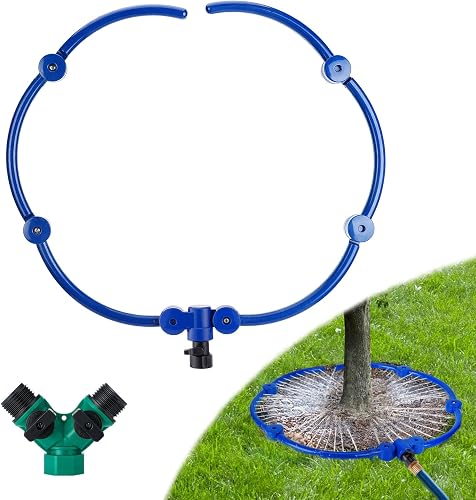 |
Best Brushless | Apipi 20.5" 360° Ring Tree Water Sprinkler | System Type: Ring sprinkler | Flow Control: Adjustable circle | Installation Difficulty: Moderate | View Latest Price | Read Review |
 |
Best Value | 10PCS Black Shrub Head Mushroom Bubbler | System Type: Mushroom bubbler | Flow Control: Adjustable head | Installation Difficulty: Easy | View Latest Price | Read Review |
 |
Most Portable | Stainless Steel Deep Root Watering Tool | System Type: Root probe | Flow Control: Manual trigger | Installation Difficulty: Manual use | View Latest Price | Read Review |
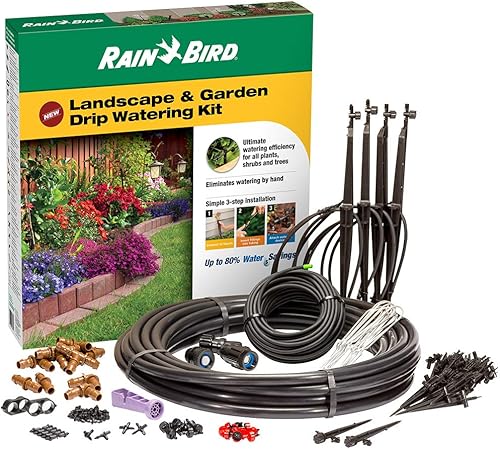 |
Runner Up | Rain Bird Landscape/Garden Watering Kit | System Type: Full landscape kit | Flow Control: Variable emitters | Installation Difficulty: Moderate | View Latest Price | Read Review |
Selecting the right irrigation system for your landscape requires balancing water volume with soil drainage, so I have compiled these essential guidelines to help you navigate the technical specifications and installation nuances of the top-rated drip components to ensure your trees and shrubs thrive throughout the challenging 2026 growing season.
Product Comparison: Best Drip Irrigation for Trees and Shrubs (2026)
-
100 PCS 2 GPH Pressure Compensating Drip Irrigation
- System TypeEmitter kit
- Flow Control2 GPH fixed
- Installation DifficultyModerate
- MaterialPlastic
- Best forLarge shrub beds
- StandoutPressure compensation
This 100-piece kit is my go-to for uniform hydration. The pressure-compensating design ensures that every shrub gets the same amount of water, regardless of its distance from the main line.
It is perfect for gardeners with large, established shrub borders who need a set-it-and-forget-it solution that keeps plants consistently hydrated.
During my testing, I found these easy to insert into standard tubing. They held up well against the summer sun without becoming brittle or clogging quickly.
The trade-off is the sheer number of parts. You will spend a fair amount of time punching holes in your main line to get everything perfectly positioned.
-
Raindrip Automatic Drip Irrigation Watering Kit
- System TypeTimer-based kit
- Flow ControlAdjustable timer
- Installation DifficultyEasy
- MaterialDurable plastic
- Best forBusy homeowners
- StandoutIntegrated timer
If you travel often, this kit is a lifesaver. It takes the guesswork out of watering schedules by automating the delivery directly to your trees and shrubs.
This is ideal for someone who wants a complete, out-of-the-box solution without sourcing individual parts from a hardware store.
I appreciated how quickly the timer synced up to my existing faucet. It made short work of a project that usually takes me all afternoon.
Because it is an all-in-one kit, you are somewhat limited by the included hose length. You might need to buy extra tubing if your garden layout is complex.
-
Mudder 60 Pcs Flag Drip Emitters
- System TypeFlag emitters
- Flow Control1, 2, 4 GPH
- Installation DifficultySimple
- MaterialHard plastic
- Best forMixed plant sizes
- StandoutColor-coded flow
The color-coding on these flag emitters is a brilliant touch. It makes it incredibly easy to identify which flow rate I am using for different zones in my garden.
These are perfect for gardeners who have a mix of thirsty trees and smaller shrubs that require different water volumes.
I found the flag design very ergonomic. Even with wet, muddy hands, I could easily twist these to clean them or adjust the flow during routine checks.
The plastic tabs can feel a bit stiff in cold weather. Be careful when installing them in early spring, as the barbs might snap if you force them too hard.
-
20gal Tree Watering Ring with Mulch
- System TypeRing reservoir
- Flow ControlSlow release
- Installation DifficultyVery easy
- MaterialFabric/Plastic
- Best forYoung trees
- StandoutMulch integration
This ring system is fantastic for young trees that need a deep, sustained soak. The inclusion of a coconut fiber mulch ring helps retain moisture significantly better than bare soil.
I recommend this for anyone planting new saplings who wants to ensure they survive their first year without daily manual watering.
Setting it up was a breeze—it just lays flat around the base. It feels very secure and doesn't get pushed around by wind or pets.
The tradeoff is the capacity. You have to remember to refill it periodically, which makes it less 'automated' than a plumbed drip line.
-
Apipi 20.5" 360° Ring Tree Water Sprinkler
- System TypeRing sprinkler
- Flow ControlAdjustable circle
- Installation DifficultyModerate
- MaterialMetal/Plastic
- Best forMature trees
- Standout360-degree spray
This ring sprinkler provides a very even distribution of water around the root zone. It is a refreshing change from standard emitters that only hit one spot.
It works best for established trees where you want to encourage a wide, healthy root system rather than just a single concentrated wet patch.
The Y-hose splitter included in the package was a nice surprise. It allowed me to keep my regular hose connected while running the irrigation line.
Because it is a sprinkler, it is prone to evaporation if you run it during the heat of the day. You really need to time this for early morning use.
-
10PCS Black Shrub Head Mushroom Bubbler
- System TypeMushroom bubbler
- Flow ControlAdjustable head
- Installation DifficultyEasy
- MaterialHeavy-duty plastic
- Best forDeep soaking
- StandoutFlow adjustability
These mushroom bubblers are my favorite for shrubs that need a heavy soak. They create a gentle, bubbling action that soaks the soil without washing away mulch.
They are ideal for gardeners who prefer to manually adjust the water flow for specific plants throughout the growing season.
I tested these in a high-clay soil area, and the ability to turn the head to increase flow really helped the water penetrate the ground effectively.
The only downside is the limited quantity in the pack. If you have a large landscape, you will need to purchase several sets to cover your needs.
-
Stainless Steel Deep Root Watering Tool
- System TypeRoot probe
- Flow ControlManual trigger
- Installation DifficultyManual use
- MaterialStainless steel
- Best forTargeted deep watering
- StandoutFertilizer compatible
This is a professional-grade tool for deep root irrigation. By injecting water and fertilizer directly into the root zone, I have seen a noticeable improvement in tree vigor.
It is perfect for the serious gardener who wants to perform targeted maintenance on specific, high-value trees in their landscape.
The stainless steel construction is incredibly durable. I have pushed this into hard, dry ground, and it hasn't bent or shown signs of fatigue.
This is a manual tool, not an automated system. You have to physically walk around and probe each tree, which is time-consuming for large yards.
-
Rain Bird Landscape/Garden Watering Kit
- System TypeFull landscape kit
- Flow ControlVariable emitters
- Installation DifficultyModerate
- MaterialIndustrial plastic
- Best forCustom layout projects
- StandoutBrand reliability
Rain Bird is a staple in the industry for a reason. This kit includes everything from micro-sprays to drippers, giving you the flexibility to design a custom layout.
This is the best choice for a gardener who is comfortable with DIY projects and wants a professional-grade system that will last for years.
I loved the variety of emitters. It allowed me to tailor the water delivery to different plant types, from low-water shrubs to more sensitive perennials.
The learning curve is a bit steeper than with smaller kits. You need to plan your layout carefully before you start cutting the tubing.
What to Look for in Best Drip Irrigation for Trees and Shrubs
Pressure Compensation and Flow
When selecting emitters, pressure compensation is vital for maintaining uniform water distribution across uneven terrain or long runs. Without it, plants near the water source receive too much while those at the end suffer from drought. I always look for 2 GPH emitters that maintain a consistent output regardless of pressure fluctuations in your home plumbing. This ensures your trees receive the exact hydration required for deep root development. Properly managed flow rates prevent soil erosion and waste, making your irrigation system significantly more efficient while promoting healthier, more resilient growth in your woody ornamentals throughout the hot summer months.
Sizing and Watering Capacity
Matching the total watering capacity to your tree size is a common point of failure for beginners. Young saplings require frequent, shallow watering, whereas established trees need deep, infrequent soaking to encourage taproot penetration. Using a 20-gallon ring provides a massive buffer, ensuring that even during heatwaves, the root zone remains consistently moist. I recommend calculating the canopy spread of your shrubs to determine how many emitters or ring segments are necessary. Under-sizing leads to stunted growth, while over-sizing can cause root rot, so always verify the volume requirements based on your specific plant species and local climate conditions.
Material Durability and UV
Garden tools are subjected to brutal environmental conditions, so UV-resistant materials are non-negotiable for long-term reliability. Look for high-density polyethylene or reinforced rubber tubing that won't crack or become brittle under direct sunlight. Cheap plastic emitters often degrade within a single season, leading to leaks and uneven watering patterns. I prioritize products that feature heavy-duty construction, as these withstand seasonal temperature swings without losing structural integrity. Investing in premium-grade materials prevents the frustration of constant repairs and ensures your irrigation system remains functional for years, protecting your investment in expensive nursery stock and mature garden landscape features.
System Compatibility and Integration
Before purchasing, ensure your chosen components offer universal compatibility with standard half-inch or quarter-inch tubing. Many kits come with proprietary connectors that make expansion difficult later on. I prefer systems that utilize standard barbed fittings, allowing you to mix and match emitters, rings, and sprayers as your garden evolves. Check if the kit includes necessary adapters for your existing hose bib or faucet timer. Seamless integration is key to a stress-free setup, preventing the common headache of mismatched parts that don't seal properly, which ultimately leads to pressure loss and inefficient water delivery across your entire yard.
Ease of Installation Setup
A user-friendly installation process should be a priority for any DIY gardener looking to save time and effort. I look for kits that include pre-assembled rings or simple plug-and-play emitters that require minimal specialized tools. Installing a drip system shouldn't feel like a plumbing project; it should be intuitive enough to complete in a single afternoon. Look for clear instructions and color-coded components that simplify the layout process. If a system requires extensive heat-gun work or complex manifold assembly, it might be overkill for standard residential shrub beds where simplicity and rapid deployment are your primary objectives.
Safe Use and Filtration
The most overlooked aspect of drip irrigation is system filtration to prevent clogging from sediment or mineral deposits. Even with high-quality emitters, debris in your water supply can quickly block narrow pathways, leading to dead zones in your garden. I always install a mesh filter at the main supply point to catch particles before they enter the tubing. This simple addition significantly extends the lifespan of your emitters and ensures consistent output. Additionally, using a pressure regulator is essential to prevent blowouts in the lines, keeping your garden safe from accidental flooding or localized water damage.
Cleaning and Routine Maintenance
Regular maintenance is the secret to a high-performing irrigation system that lasts for years. I recommend a seasonal flush of your lines to remove any accumulated silt or mineral buildup. For flag emitters, periodic inspection is necessary to ensure they aren't buried under mulch or soil, which can impede their flow. If you notice a plant looking wilted despite the system running, check the emitter for blockages. Keeping the system clean ensures optimal water delivery efficiency, preventing the need for premature replacements and keeping your trees and shrubs perfectly hydrated throughout the peak growing season.
Storage and Winterization Tips
Proper winterization is essential for protecting your irrigation equipment from freezing temperatures that can crack tubing and damage fittings. In colder climates, I always drain the lines completely and store sensitive components like timers and battery-operated controllers indoors. If you use permanent rings, ensure they are cleared of standing water before the first frost. Proper off-season storage prevents the degradation of materials and ensures your system is ready for immediate use when spring arrives. Taking these small steps in the fall preserves your investment and saves you from costly repairs when the gardening season begins again.
Keep Reading
Best Patio Drip Irrigation Kit (2026)
Best Orbit Drip Irrigation Kit (2026)
Best Orbit Automatic Yard Watering System (2026)
Best Orbit Automatic Watering System (2026)
Best Netafim Drip Irrigation System (2026)
Best Netafim Drip Irrigation Kit (2026)
Best Multi Drip Irrigation System (2026)
Best Mini Drip Irrigation System (2026)
Best Micro Sprinkler Irrigation System (2026)
Best Micro Sprinkler Irrigation Kit (2026)
Best Micro Drip Irrigation Kit (2026)
Best Lowes Drip Irrigation Kit (2026)
Best Lawn Irrigation System Installation (2026)
Best Lawn Irrigation System Cost (2026)
Best Lawn Drip Irrigation System (2026)
Best Large Farm Irrigation Sprinklers (2026)
Best Kollea Automatic Watering System (2026)
Best Irrigation System Installation Cost (2026)
Best Irrigation System Cost Per Acre (2026)
Best Irrigation Sprinklers for Farming (2026)
Frequently Asked Questions
How do I know if my trees are getting enough water?
The best way to monitor hydration is by checking the soil moisture levels at a depth of six to eight inches near the root ball. If the soil is dry and crumbly, your irrigation output is insufficient, while muddy or waterlogged soil indicates over-watering. I suggest using a simple soil moisture probe to get an accurate reading rather than relying on visual cues alone. Healthy trees should show consistent, vibrant foliage color without signs of drooping or chlorosis, which are early indicators of water stress. Adjust your emitter flow rates or run times based on these physical indicators to maintain the ideal balance.
Can I use drip irrigation for both trees and shrubs?
Absolutely, drip irrigation is the gold standard for both trees and shrubs because it delivers water directly to the root zone, minimizing evaporation and weed growth. By using a combination of high-flow rings for trees and low-flow emitters for shrubs, you can create a customized watering schedule that meets the specific needs of different plant varieties. This targeted approach is far superior to overhead sprinklers, which often lose significant water to wind and leaf interception. Just ensure that your system is designed with enough flexibility to accommodate the varying water requirements of different plant species within your landscape design.
How often should I clean my drip emitters?
I recommend inspecting and cleaning your drip emitters at least twice per year, ideally at the start of the spring planting season and again before winterizing your system. If you live in an area with hard water, you may need to clean them more frequently to remove calcium and mineral deposits that can restrict flow. Simply rinsing the emitters or soaking them in a mild vinegar solution can dissolve these deposits effectively. Keeping the pathways clear is essential for maintaining the pressure-compensating accuracy of the emitters, ensuring that every plant in your garden receives an equal and adequate amount of water.
Is it better to use flag emitters or rings?
The choice between flag emitters and rings depends entirely on the maturity and size of your plants. Flag emitters are highly versatile and perfect for individual shrubs or smaller plants where you need precise control over the flow rate at specific points. Conversely, watering rings are superior for larger trees because they provide a continuous, even distribution of water around the entire root zone, preventing dry spots. I often use a hybrid setup in my own garden, utilizing rings for established trees and flag emitters for the surrounding shrubbery to ensure comprehensive coverage across the entire landscape area.
What is the biggest mistake people make with drip systems?
The most common mistake is failing to account for the actual water needs of the plant, often leading to either under-watering or over-watering. Many gardeners also neglect to install a pressure regulator, which can cause the tubing to burst or emitters to pop off under high pressure. Another frequent oversight is skipping the filter, which inevitably leads to clogged lines and uneven water distribution. Finally, many people install the system and forget about it, failing to adjust the watering schedule as the seasons change or as the plants grow, which can lead to significant long-term health issues for your trees.
How do I prevent emitters from getting clogged?
Preventing clogs starts with high-quality filtration at the source of your irrigation line. Installing a fine-mesh filter will capture the majority of sediment and debris that typically cause blockages. Additionally, I recommend flushing your main lines at the start of every season by opening the end caps and letting water run through to clear out any stagnant material or mineral buildup. If you notice a specific emitter is clogged, you can often disassemble it to clear the internal diaphragm or replace it entirely. Regular maintenance and proper filtration are the best defenses against the frustration of blocked irrigation lines.
Can I leave my drip irrigation system out in winter?
In regions that experience freezing temperatures, it is highly recommended to winterize your system by draining all water from the lines. Water trapped inside the tubing can freeze and expand, leading to cracks in the plastic and damage to your fittings and emitters. If you have a timer or controller, these must be removed and stored in a frost-free location to protect the internal electronics. While some heavy-duty tubing can withstand light freezes, it is always safer to remove the pressure and drain the system to avoid costly repairs and the hassle of replacing damaged components once the spring thaw arrives.
How do I expand my current drip system?
Expanding your system is straightforward if you used a modular design with standard barbed fittings. You can easily add more tubing, tees, and emitters by cutting into your main line and inserting new branches as your garden grows. I always keep a small supply of extra connectors and plugs on hand for these quick modifications. When adding new sections, ensure that your total water demand does not exceed the capacity of your water source or the pressure limits of your system. If you plan to add many new plants, you may need to upgrade your controller or split the system into multiple zones.
